Reviews
Part of How to read an annual trend report in about twenty minutes
An annual trend report moves through stages before its real date shows
Annual trend reports timeline from field work to release: what each production stage does to the content, and how to recover the date that matters.
Every report is older than it looks. Months pass between the day the data was collected and the day you read the finished document. Nothing in the document's design tells you how long.
This page walks the calendar of a report from field to publication. It says what each stage does to the content. It explains why the lag belongs to the genre, not to a publisher's failure.
What to take away
- The date on the cover is the publication date. The date that matters is when the material was collected, and it is usually months earlier.
- Every stage of production pushes the document toward being more confident and less specific, which is the opposite of what a reader needs.
- A report describing a fast-moving subject is at its least reliable exactly where it is most quoted.
The stages, and the lag each adds
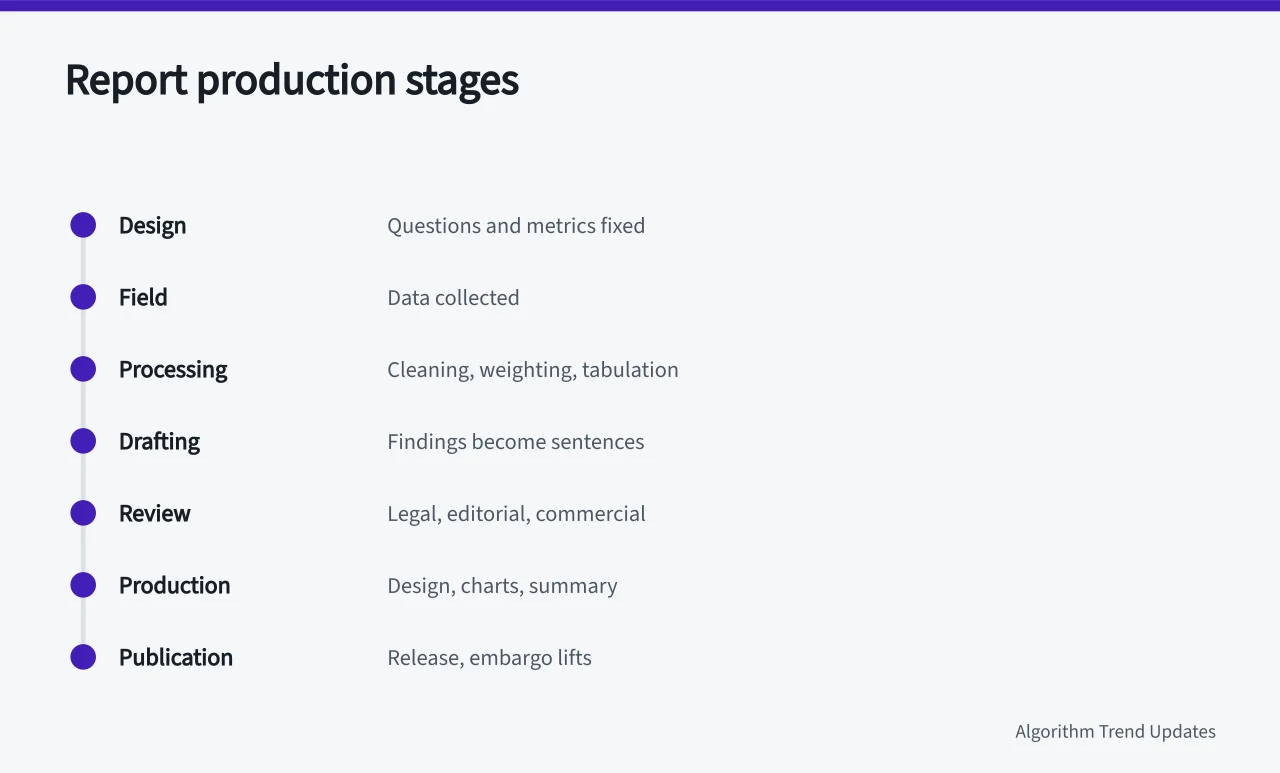
| Stage | What happens | Typical effect on the content |
|---|---|---|
| Design | Questions and metrics are fixed | Locks in the definitions before anything is known |
| Field | Data is collected | This is the moment the report actually describes |
| Processing | Cleaning, weighting, tabulation | Nothing yet is written; the numbers settle |
| Drafting | Findings become sentences | Hedges get lost; direction becomes conclusion |
| Review | Legal, editorial, sometimes commercial | Specifics get softened, awkward findings get shortened |
| Production | Design, charts, summary | The summary is written last and read first |
| Publication | Release, embargo lifts | Coverage is written from the summary |
The design stage is worth pausing on, because its effect is the largest and it happens before anything is measured. Whatever was not asked in the design cannot appear in the report, however the year turns out.
A questionnaire written in one quarter is answering the questions that seemed interesting in that quarter, and those are set by a stream of platform changes that never pauses for a research calendar. That stream is the subject of why the flow of change never stops.
The drafting and review stages do something subtler. Both push in the direction of confidence: a hedged sentence reads as weak, a specific claim invites challenge, and the version that survives review is usually more general and more assured than the version that entered it. Nobody intends this and it happens almost every time.
Why the lag is unavoidable
It is easy to read the delay as slackness. It is mostly arithmetic. Collection takes as long as it takes to reach enough people. Processing cannot start until collection ends. Drafting cannot start until processing is done, and review cannot start until there is a draft.
Compressing the sequence means collecting less or reviewing less. Both carry costs a publisher can reasonably decline.
A publisher can cheaply state field dates prominently. Those that do show they take the problem seriously. The reference practice is public: Pew Research Center's account of how it runs and describes its own research treats field dates as part of the finding, not an administrative detail.
What the lag does to a fast-moving subject
The faster the subject moves, the more the lag costs, and the relationship is not linear. For a slow-moving subject the report describes a state that is still roughly current. For a fast-moving one, the report describes a state that has been replaced, and it describes it with the confidence that the production process added.
This is the same clock problem that makes specific advice expire so quickly. The report version is worse in one respect: a document looks permanent in a way a post does not, so it keeps being cited long after an equivalent post would have been forgotten.
Two practical consequences follow. Structural claims in a report age well, so read those. Anything with a level or a rate in it should be read as a historical statement about the field period, which is the reading discipline that sorting claims by expiry is built around.
Recovering the real date
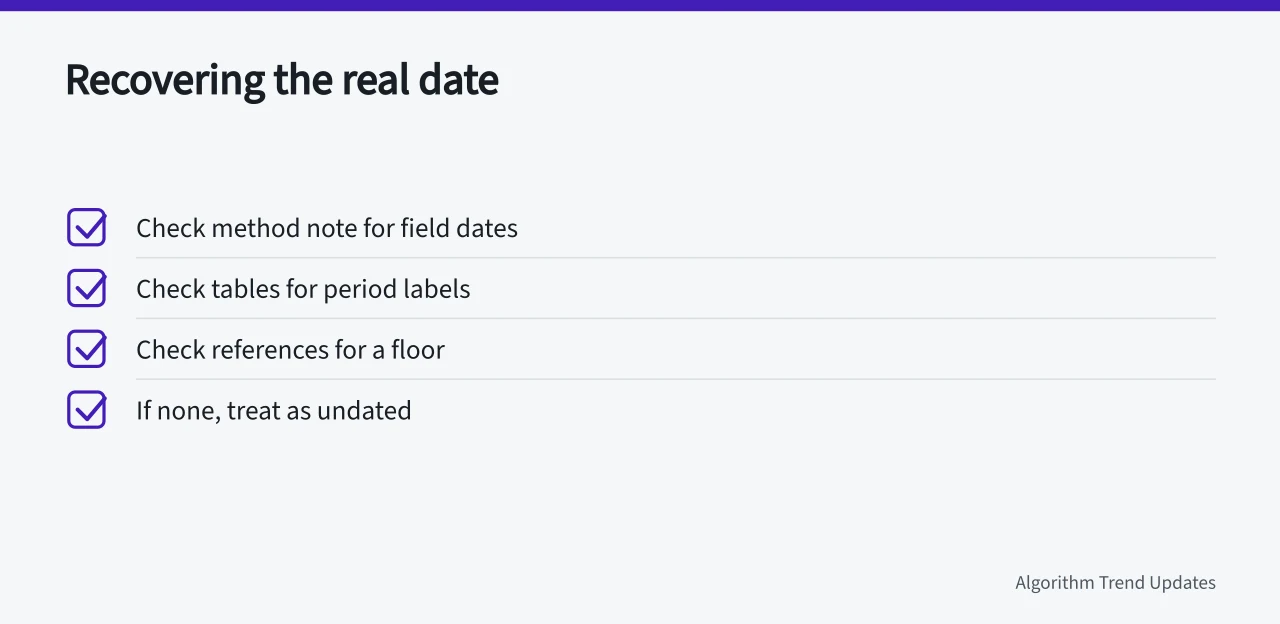
The method note, which normally states field dates directly. It is the document's own primary source about itself, and if it gives you dates you are done: the rest of the report can be read against them.
The tables, which sometimes carry period labels the prose does not. A table headed with a quarter tells you more than a cover headed with a year.
The references, which give a floor. A report citing nothing later than a given month was probably drafted around then, which is a crude estimate and better than nothing.
If none of the three yields anything, treat the document as undated rather than as recent. That is the same rule that applies to any unmarked claim about a system, and it is not a harsh one: an undated finding cannot be placed against anything else, which is what makes it unusable rather than merely old.
Common questions
How long is the lag, typically?
It varies enormously and any general figure would be invented. What is reliable is the ordering of the stages and the fact that the lag is never zero. Ask for the field dates rather than estimating.
Is a fast-published report better?
Not necessarily, and it may be worse. Speed is bought from collection or from review, and losing either has costs. What is genuinely better is a slow report that says clearly when its material was collected.
Why do reports get published at the same time every year?
Because the calendar is a product decision as much as a research one, and an annual release is easier to sell and to plan around. It also means the field period is fixed in the year regardless of whether that period is representative, which is one more thing to check when comparing two editions.
Should I wait for the next edition instead?
Rarely worth it. The next edition will have the same lag and may have broken the series in the meantime. Use what is in front of you, attach the right date to it, and stop treating it as a description of now.