Guides
Part of How to read an annual trend report in about twenty minutes
Annual trend reports risks: what to keep and what to drop, 2027 edition
Annual trend reports risks from who paid for them: where funding shapes questions rather than numbers, and how to read a sponsored report anyway.
Somebody paid for the report you are reading, and that fact changes how to read it without making it false.
Most trend research in circulation was funded by an organization with a commercial interest in the conclusion. That funding is neither a scandal nor hidden. It is the ordinary condition of the genre, so the skill is reading such a document for what it can still tell you.
What to take away
- Funding does not usually corrupt the numbers. It shapes the questions, the framing, and what gets left out, which is harder to see and often more consequential.
- The absence of an inconvenient finding is the most common effect and the least detectable one. Look for what a report does not measure.
- A funded report can be perfectly usable if you read the method and ignore the summary.
Where the influence actually enters
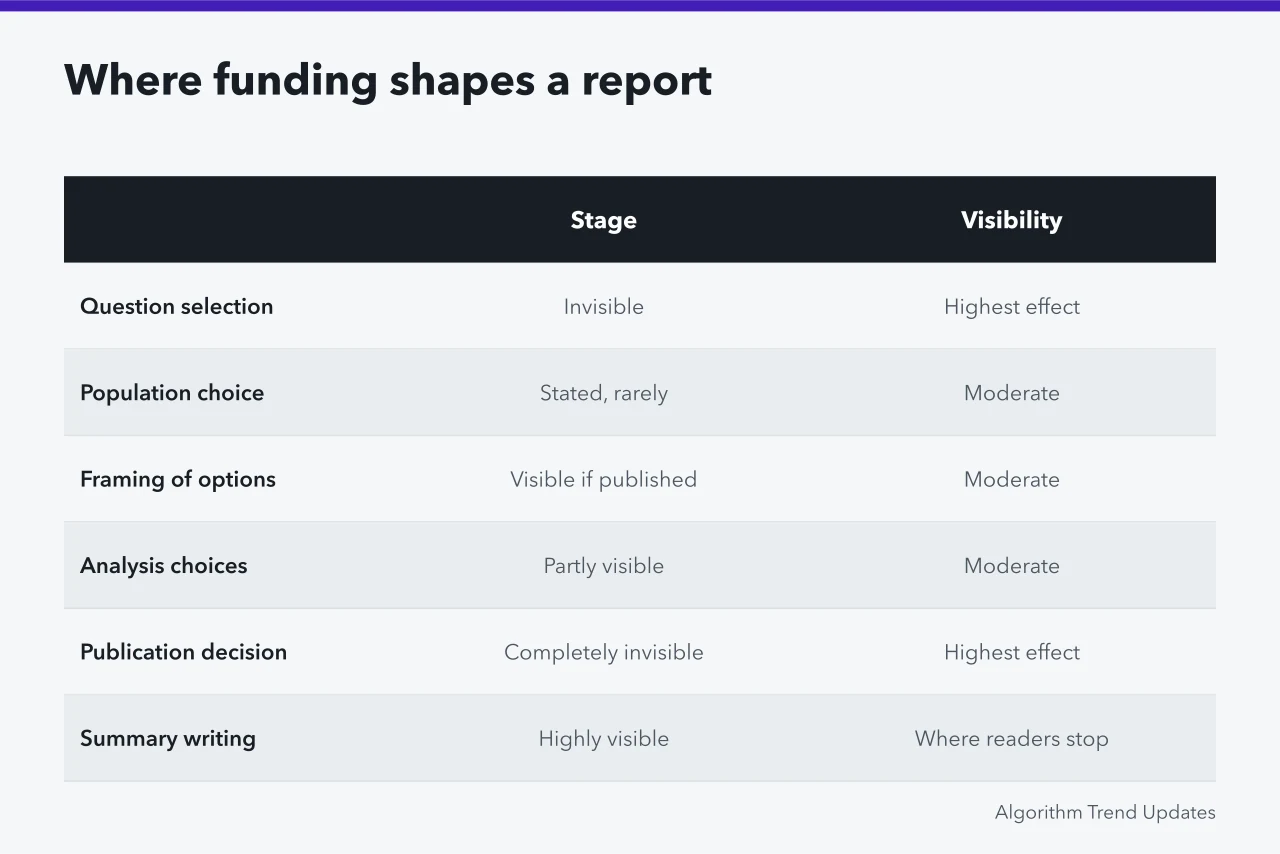
| Stage | How funding shapes it | How visible it is |
|---|---|---|
| Question selection | Which questions get asked at all | Invisible; you see only what was asked |
| Population choice | Who is surveyed or measured | Usually stated, rarely examined |
| Framing of options | The answer choices offered | Visible if the instrument is published |
| Analysis choices | Which cuts get reported | Partly visible from the tables |
| Publication decision | Whether a result is published | Completely invisible from outside |
| Summary writing | Which finding leads | Highly visible, and where most readers stop |
The first and fifth rows carry almost all of the effect. Nobody has to alter a number if the question that would have produced an awkward number was never asked, or if a study that produced one was quietly not published. That second mechanism is publication bias in its plainest form, and it is not confined to commercial work.
The version where sponsor interest predicts a result's direction across many studies is well documented. It has a name: funding bias. Knowing it exists beats trying to spot it in one document, where it is usually invisible.
Where a report sits in the order of what each kind of evidence supports matters more than the name on its cover.
What disclosure does and does not do
A declared conflict of interest is a good thing and a weak protection that tells you the relationship exists. It does not tell you what the relationship did.
No evidence shows that knowing about a conflict helps readers discount for it accurately, and most people dismiss the whole document or, more commonly, note the disclosure and read on unchanged.
The useful response is not to weight the conclusion. It is to change which parts of the document you read. A funded report's method section is usually as honest as an unfunded one, because the people who wrote it are describing what they did. The summary is where the interest lives, because the summary is written to be quoted.
Reading one anyway
Four moves, in order.
Read the method before the findings. If the method is not published, stop; you have a marketing document, which can still be interesting and cannot be cited.
Find the population. Who was measured, how they were reached, and how many declined. That last figure is the one most often absent and most often decisive.
Look for the missing measurement. Ask what a skeptic would have wanted measured, then check whether it was. Its absence is the single most informative thing in most funded reports.
Read the tables, not the summary. The summary selects; the tables are what was found. Where the two disagree in emphasis, the tables are the document.
Two of these are just the general discipline for qualifying a figure before you quote it, applied with a sharper eye. The rest is specific to documents written to persuade.
The formal machinery, and its limits
Academic publishing has processes for this: peer review, declared interests, and pre-registration of what will be measured. They help, imperfectly, and almost none of the trend research you will meet has been through any of them.
That matters less than it sounds, if you adjust. A careful reader with the method section can catch most of what these processes catch. The exception is the unpublished study.
Nothing available to you fixes that. So one report, however good it looks, should never settle a question. Reading several side by side is worth the extra hour.
Common questions
Should I ignore vendor-funded research entirely?
No, and doing so would remove most of the available material in this field. Read the method, use the descriptive findings, and treat the recommendations as advertising, which is what they are and what the authors would probably concede. Setting several of them beside each other is the job of the comparison of trend sources.
How do I tell a marketing document from a research report?
By whether the method is published in enough detail to be criticized. That single test separates them more reliably than the publisher's name, the design, or the presence of charts.
What if the finding matches what I already believed?
Then apply more scrutiny rather than less. A funded report agreeing with your prior is the situation in which you are least likely to check the method, and it is the situation in which checking pays most.
Does a government or academic source avoid the problem?
It shifts the interest rather than removing it. Public bodies have mandates and reputations; academic work has publication incentives. The questions remain the same. Answers are more often available, which is the real advantage.
Who paid is separate from the maintenance a report needs after publication. Both must be checked.