Maintenance
Part of How to read an annual trend report in about twenty minutes
Annual trend reports: the parts worth your attention
Annual trend reports guide to what a document owes its readers after publication: claim expiry rates, correction practice, and reading an unmaintained one.
A report is published once and read for years, and that is the problem. The document stays the same while the world it described does not, so the reader cannot tell how much has changed.
This page covers maintenance. It explains what a publisher owes a report after publication, what a reader can do when nobody maintained it, and how to keep your own work from becoming what you criticize.
What to take away
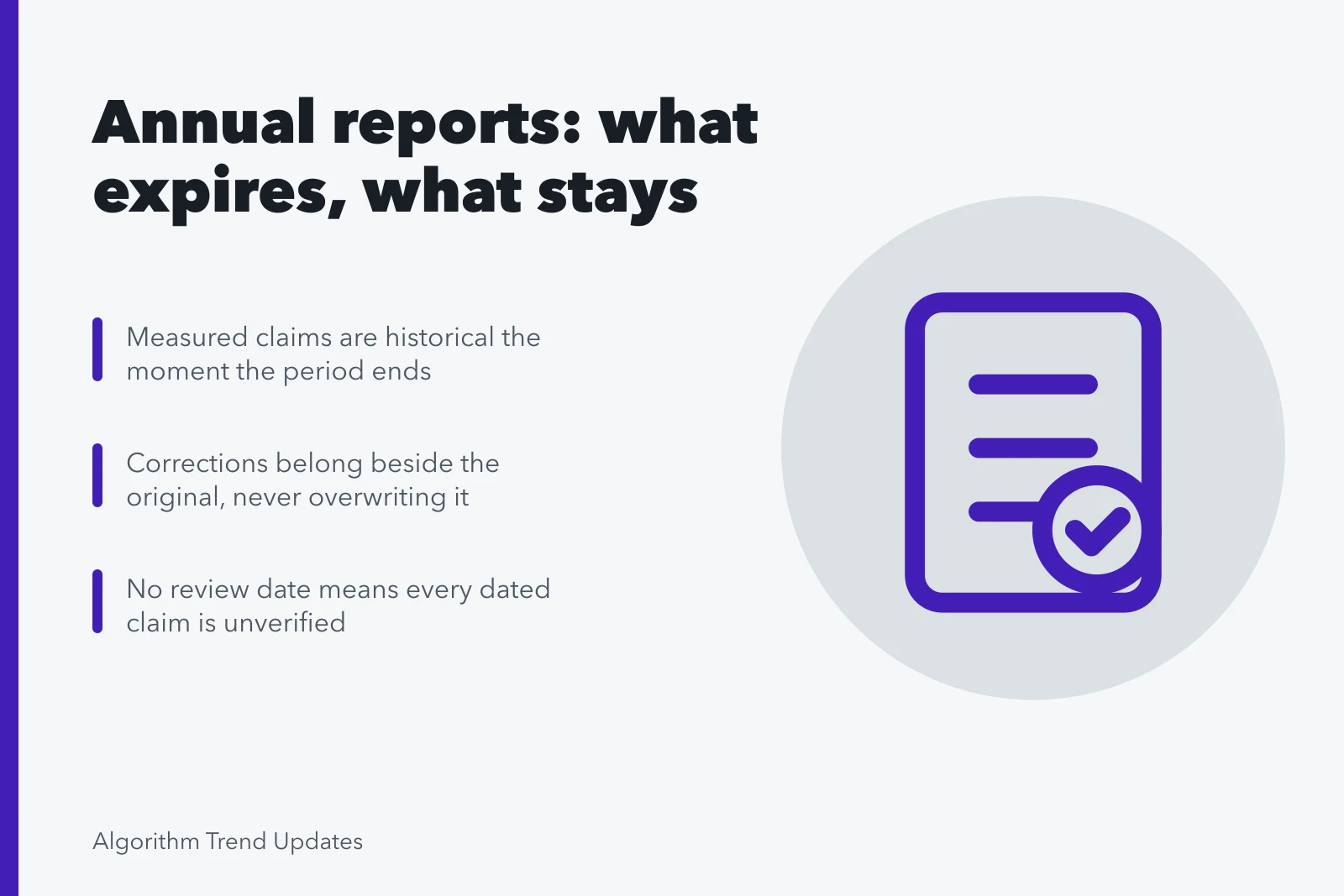
- A report's claims expire at different rates. Sorting them by expiry is the whole of the maintenance problem.
- A correction that overwrites the earlier value destroys the record. Corrections belong beside the original, not on top of it.
- If a document carries no review date, treat every dated claim in it as unverified rather than as old.
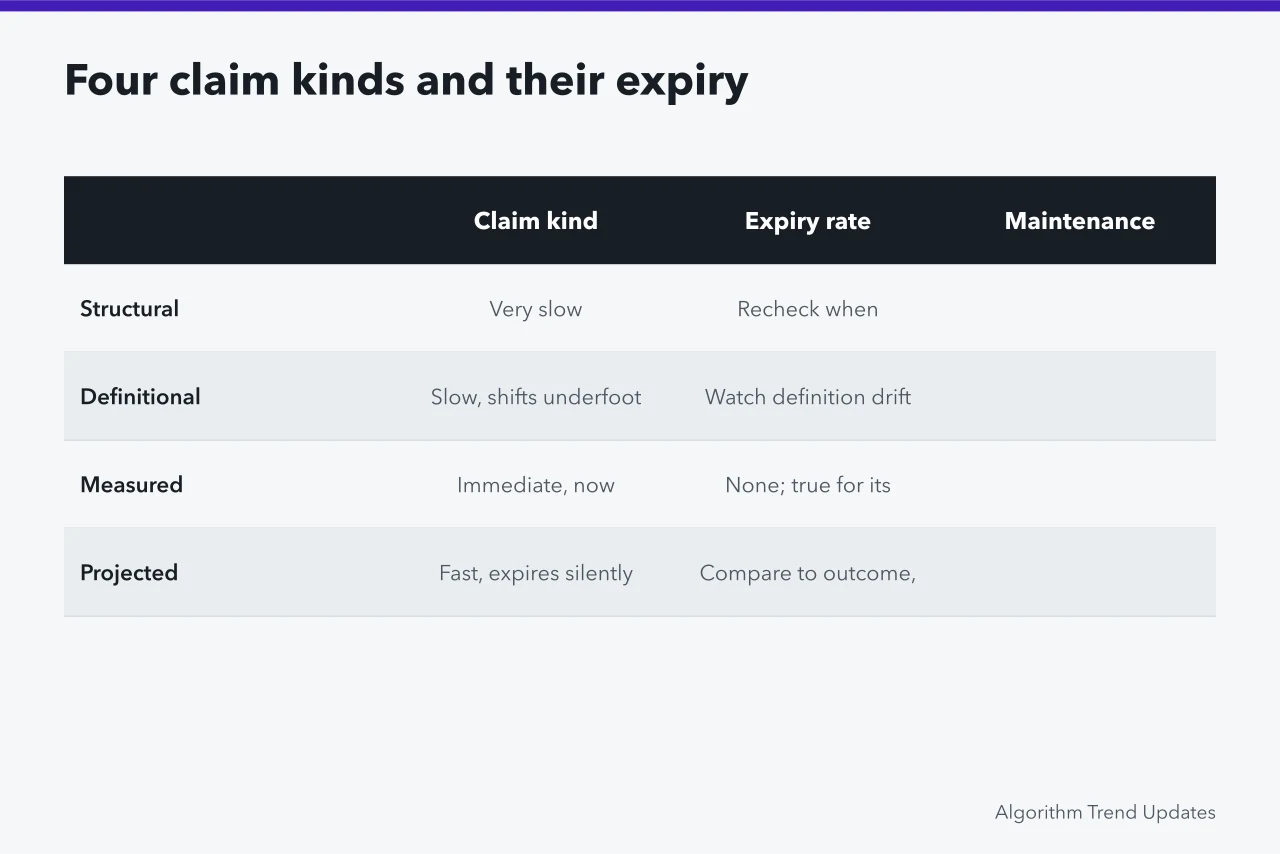
Four kinds of claim, four expiry rates
| Kind of claim | Example shape | Expiry | What maintenance means |
|---|---|---|---|
| Structural | Why a thing has to work this way | Very slow | Re-examine when the constraint changes |
| Definitional | What a term is being used to mean | Slow, but shifts underfoot | Watch for the definition changing outside the document |
| Measured | What a number was in a period | Immediate, in the sense that it is now historical | Nothing; it was true then and stays true |
| Projected | What is expected to happen | Fast, and expires silently | Compare against what happened, and say so |
The measured row gets mishandled both ways. A figure tied to a period does not go stale; it was a statement about that period. Quoting it as if it describes now goes stale. That is a reading error, not a defect in the report.
The habit of reading a report in twenty minutes mostly means asking which period each number belongs to.
The projected row is the dangerous one, because a projection that did not come true leaves no trace. Nobody publishes a note saying last year's expectation was wrong. That silence is what allows the next projection to be read with the same confidence as the last.
What a maintained report looks like
Four properties, none of them expensive.
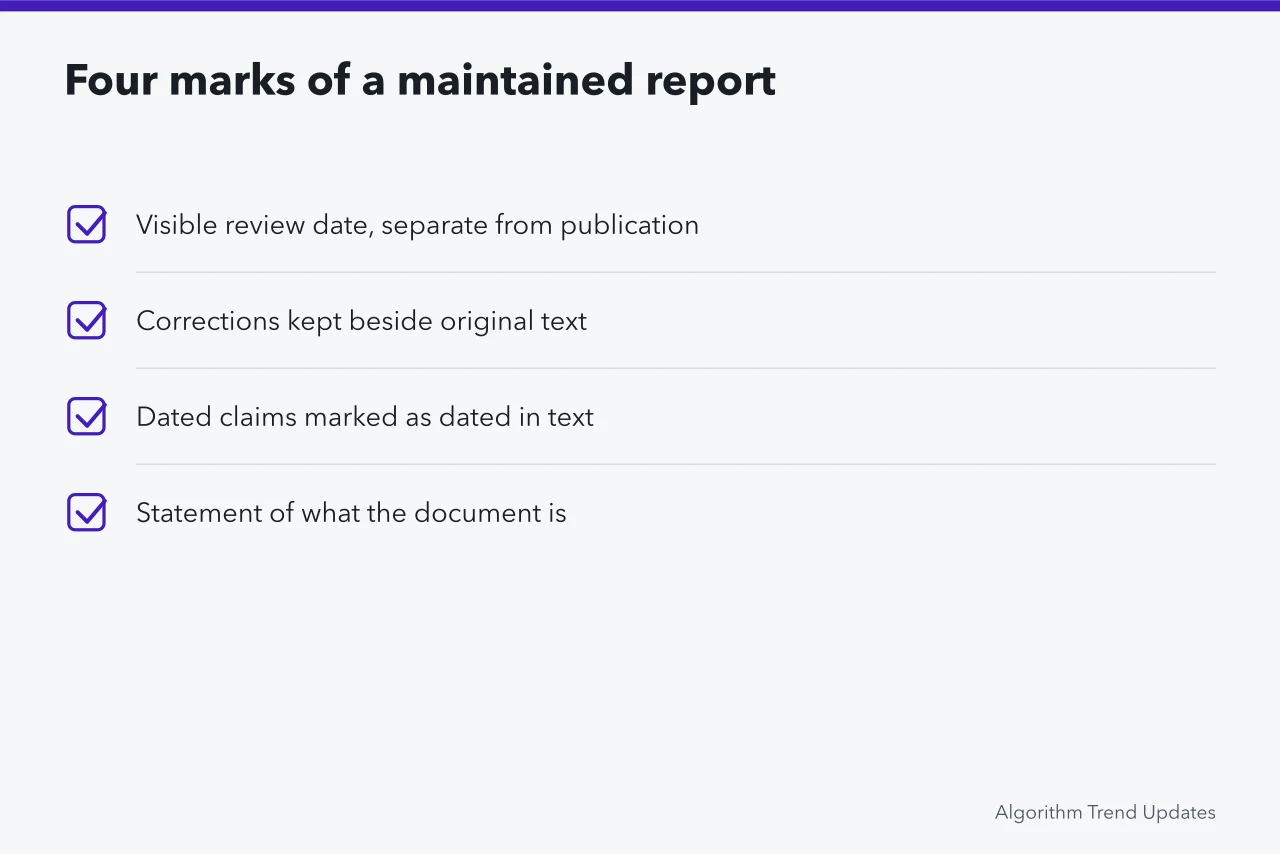
A visible review date, distinct from the publication date and from the last edit. The last edit tells you when a typo was fixed. A review date tells you when somebody checked whether the claims still held.
Corrections held beside the original text, with what changed and why. Overwriting a value and saying nothing makes a careful update indistinguishable from an unexplained rewrite, and it removes the reader's ability to judge either.
Dated claims marked as dated, in the text rather than in a footer. A sentence that reads as current when it describes a period two years ago is the most common failure in this whole subject.
A statement of what the document is. Whether it is a survey report, an analysis of existing sources, or a marketing document with data in it. That is usually clear to the publisher and rarely to the reader, and where a document sits among your sources decides most of what a reader should do with it.
Reading an unmaintained report
Most of what you meet has none of the above, so the work falls to you. Three steps, in order.
Establish the period the document is about, which is often different from the year in the title and is sometimes only recoverable from a methods note. Reports are frequently named for the year of publication and describe the year before.
Sort the claims by the table above, mentally or on paper. Structural claims can be read directly. Measured claims need their period attached before they can be used. Projections should be read as the authors' expectation at the time and nothing more.
Check one claim against its own source, not all of them, chosen because it matters to you. What you learn from a single trace about the document's relationship to its sources usually generalizes.
The move is tracing a claim back to where it stops, which works the same for a report as for a date on a calendar.
Most published research of this kind is gray literature, produced outside formal publishing channels and outside the review processes that would catch some of this. That is not a reason to dismiss it. It is a reason to do the trace yourself.
Keeping your own work maintainable
Three habits, and they cost minutes rather than hours.
Write the period into the sentence, not into the metadata. A reader who arrives from a search result never sees your header.
Keep a source note per claim, even privately. The cost of finding a source again a year later is many times the cost of writing it down once, and provenance is exactly the property you are preserving.
Separate what you measured from what you expect. Mixing them in one paragraph makes both unusable later, because nobody can tell which was which. The general discipline for what a claim can carry is set out in what each kind of evidence supports, and it applies to your own writing before it applies to anyone else's.
Common questions
How old is too old?
There is no general answer, and the question is the wrong one. Ask instead which of the four kinds of claim you are relying on. A structural argument from five years ago may be fine; a measured figure from last quarter may already be the wrong period for your purpose.
Should a publisher update a report or issue a new one?
A new one, with the old left in place and a link between them. Updating in place destroys the ability to see what changed, which is the thing a reader most needs when two versions disagree.
What if a report has been quietly edited?
You usually cannot tell, which is the argument for treating unmarked documents as undated rather than as current. Where the stakes justify it, keep your own copy of what you read, so your citation refers to something fixed.
Is any of this different for a report you paid for?
Only in that you can ask. A paid report should be able to tell you its field dates, its method, and when it was last reviewed. If it cannot, the price bought presentation rather than maintenance, and the same absence of a stated method is what makes most figures in this field unquotable.