
Costs
Part of Only one of the two engines behind a viral trend can be planned
The risks of going viral arrive in a predictable order
Viral trends risks in the order they arrive: the mismatched audience, the unreadable baseline, and the pressure to repeat that forms afterward.
A hit is treated as a windfall, which is why its costs go unbudgeted. Some of them are immediate and obvious once you have lived through one: the support load, the moderation load, the week you lose. Others are slower and more expensive, and the worst of them is that a hit changes who your audience is without asking you. This page sets out what a burst of attention costs, in the order the costs arrive.
What to take away
- The audience a hit brings is selected by the hit, not by you, and it is usually a poor match for everything else you make.
- The most durable damage is to your instruments: after a hit, your own baseline is unreadable for as long as the spike lasts and some time after.
- A hit is a poor input to a decision, because it is one observation drawn from the extreme tail of your own distribution.
The costs, in arrival order
| When | Cost | Why it is missed |
|---|---|---|
| Hours | Support and moderation load on a team sized for a normal week | Nobody plans capacity for the outlier |
| Days | Attention displaced from everything scheduled | It feels like the right call at the time |
| Weeks | An audience acquired on one thing, expecting more of it | The new numbers look like growth |
| Weeks | A baseline that no longer describes anything | Instruments are assumed to be neutral |
| Months | Pressure to repeat, applied to every subsequent decision | The pressure is internal and rarely named |
| Months | A public association with a single item | Only visible when you try to move on |
Audience mismatch is the expensive one
The people who arrive during a burst arrived for the item, and the item is by construction unrepresentative of your work: it is the thing that traveled, which almost always means it was more extreme, funnier, angrier or simpler than your usual output. The audience that follows it is selected on that property, and the route that brought them was set by the structural conditions on the surface rather than by you.
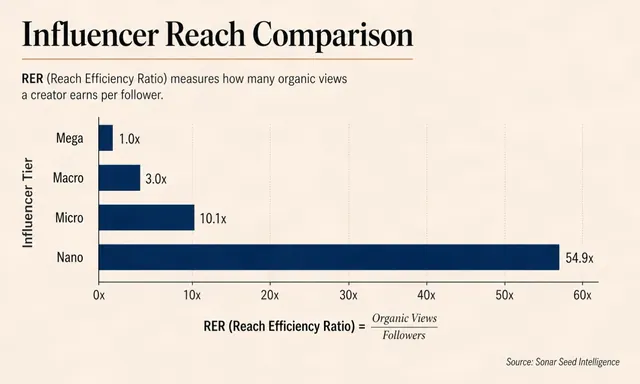
What happens next is predictable. Your ordinary material now reaches a group that did not come for it. Response rates fall, not because the material got worse, but because the denominator changed. If your instruments report engagement as a rate, they will now report a decline that has no relationship to anything you did. Reading that decline as a quality problem, and adjusting the work to fix it, is how a single hit reshapes an operation over a year.
The cleanest way to see this is to keep the cohorts apart: people who arrived before the burst and people who arrived during it, measured separately, for as long as it takes for the difference to stop mattering. Aggregating them destroys exactly the information you need. The mechanics of that separation are the same ones described in reading a cohort rather than a total.
The incentive that forms afterward
Once a burst has happened, it becomes the reference point. Every subsequent piece is judged against the best week you ever had, and the pressure to reproduce it is applied by people who mean well, including you.
This is an ordinary perverse incentive: the measure that was supposed to indicate that things were going well becomes the thing being pursued, and pursuing it degrades what it was measuring. In practice it pushes work toward whatever traveled last time, which is a narrower target than your actual subject and one that stops working as soon as several people aim at it.
The pressure is worse when the thing that traveled was provocative. Material that produces a strong reaction spreads efficiently, which is a fact about the mechanism rather than about the material's worth. Chasing that efficiency deliberately moves you toward clickbait, a term that names a real and specific failure: a promise in the packaging that the contents do not keep. The cost is paid the second time, when the audience remembers.
The wider version of this trade, where attention rather than money is the scarce resource being competed for, is the subject of the attention economy, and it explains why the pressure is structural rather than a failure of character.
Costs you do not control
Some of the risk is not yours to manage. A burst can attract organized hostility, or a wave of accounts with no relationship to your subject, or an association with a dispute you had no part in. None of these are preventable and only the response is in your hands.
The useful preparation is deciding in advance what you will not do: which comment sections you will not enter, which claims you will not respond to, and at what point you stop reading. Deciding this during a burst is deciding it badly. The general form of the argument, that some of the risk in any system belongs to somebody else, is set out in the risks that are not yours.
What a hit is actually good for
It is good for two things. It is evidence that a route to a wide audience exists from where you are, which you may not have known. And it is a supply of new material, in the form of what people said when they arrived, which is often the most honest description of your work you will ever get.
It is not evidence that the thing you made was good, and it is not a plan. One draw from the tail tells you almost nothing about the distribution.
Common questions
Should I avoid trying for reach at all?
No. The argument is for pricing it, not for refusing it. Knowing that a hit brings a mismatched audience and an unusable baseline lets you decide whether this attempt is worth those costs, which is a decision you can only make before. Price it against the ratio worth measuring, not against a total.
How long does the baseline stay unreadable?
Until the burst audience has either engaged or gone quiet, which takes longer than the spike does. There is no fixed figure and anyone offering one is guessing. Watch for the point where your rates stop moving, then treat that as the new normal rather than trying to restore the old one.
Is a smaller, slower audience genuinely better?
For most operations, yes, because it is an audience selected by your ordinary work rather than by one outlier. That is a defensible position and not merely a consolation, though it is worth being honest that it is also slower.
What if the hit is on a subject I do not want to be known for?
Then the association is the main cost and it will outlast the numbers. The only real response is to keep producing what you actually do, accept a period of poor rates while the mismatched audience settles, and resist the pull described above. The decision about what not to do is worth writing down before you need it.