Reviews
Recommendation systems platforms compared: what US platforms actually deploy
Six US platforms compared by retrieval stage, ranking signal and public detail, plus what each architecture forces a publisher to do before committing.
What to take away
- Six large US recommendation systems platforms share one two stage shape: retrieval cuts millions of items to a few hundred candidates, then a ranker orders them.
- They differ in the ranker objective. TikTok and YouTube lean on completion and watch time, LinkedIn leans on professional fit and dwell, X leans on fast engagement.
- Instagram, YouTube and X publish the most architecture detail. LinkedIn and Facebook publish the least.
- Copying one content shape across all six raises trial cost, because each ranker rewards a different opening second.
How recommendation systems work in two stages
Almost every large US feed follows the same outline. A retrieval stage narrows millions of items to a few hundred candidates. A ranking stage scores those candidates with a neural network and returns an ordered list. YouTube described that split in a 2016 paper by Covington, Adams and Sargin.
Two-Stage Recommendation Pipeline
- Millions of items enter retrieval
- Retrieval narrows to a few hundred candidates
- Ranking scores candidates with a neural network
- Ranker returns an ordered list
Retrieval itself varies by platform, from collaborative filtering over co-watch data to graph walks and embedding similarity.
The ranker is where platforms part. Each one picks a different objective and a different weight set, and those choices decide which posts travel and which stall. Recommendation engine platforms such as Netflix and Amazon use the same split.
Where the six big US platforms differ
| Platform | Candidate sources | Dominant ranking signal | Public detail |
|---|---|---|---|
| TikTok | co-engagement, content embeddings, follows | watch completion, replays, shares | help center pages on the For You feed |
| follows, Explore graph, Reels embeddings | watch time, sends, saves | Mosseri's 2023 ranking note | |
| YouTube | watch history, co-watch graph | watch time, satisfaction surveys | 2016 recommender paper |
| X | follow graph plus out of network posts | likes, replies, reposts, reduced reach for outbound links | 2023 open source release |
| connections, skills, employer graph | dwell, professional relevance | help pages on feed ranking | |
| social graph, groups, Reels | comments, shares, watch time | limited public detail |
Read that table across the rows. TikTok, Instagram and YouTube Shorts all reward completion, so the first second carries weight on all three. LinkedIn rewards slower signals. X rewards reaction speed, which makes live windows valuable.
TikTok's own account of the For You feed lists user interactions, video information and device settings as inputs, and its recommendation algorithm has drawn heavy outside study.
LinkedIn is the outlier. Reach depends on the professional graph rather than raw watch time, as the platform's feed ranking history describes, so a post that reaches recruiters can stall with engineers.
Example: one Reel reaching a stranger
One Reel reaching a stranger
- A retrieval model pulls Reels from accounts you do not follow, using embeddings built from your past watches.
- The ranker scores each candidate on predicted watch time, sends, saves and likes, with sends weighted heavily for out of network picks.
- A policy layer removes duplicates, near repeats and anything failing integrity checks.
- The ordered list is cached, then re-scored in the next session as fresh engagement arrives.
Every step is a place where a publisher loses distribution. Step one fails if your Reel looks like nothing the model has seen from you before. Step two fails if the opening frame gives no reason to stay.
Retention beats clicks in short video
Short video rankers do not reward the click. They reward what follows it. YouTube Shorts reports viewed versus swiped away, and retention curves sit in Studio, as the YouTube Shorts overview describes.
Completion rate is the objective, not click count. A short clip that most viewers finish outranks a longer clip that most viewers abandon, because the model learns from the swipe rather than the impression. Publishers who lengthen a working format usually lose reach first.
What the platform differences force on publishers
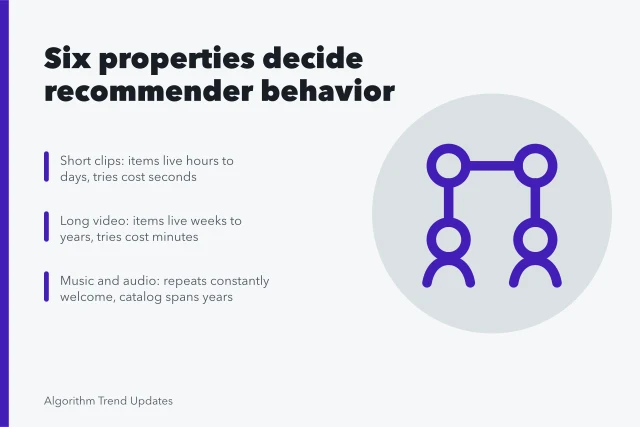
Each architecture pushes a different cost onto the publisher. TikTok and Reels reward volume and rapid iteration. YouTube rewards a back catalogue that keeps earning watch time. LinkedIn rewards consistency from named people with visible roles. X rewards posting inside live reaction windows.
That is the ground the working brief on recommendation systems platforms covers next. It compares six platforms by item lifetime, trial cost, error cost and integration effort, then sets out what each shape forces a publisher to do.
What holds up under review
Social media recommendation algorithms inherit this split, and a fair recommendation system comparison starts with inputs rather than outputs. Platform documentation states what a ranker claims to optimize. Independent testing shows what it does.
So what holds up and what does not starts from those two families of evidence, then works through the cold start problem, why popularity concentrates, and what relevant means inside a single system.
Nothing published suggests recommendation systems 2027 will differ in outline, only larger rankers and tighter policy layers.